“PopAi at a Glance: A Critical Evaluation of Its Value Proposition and UX”
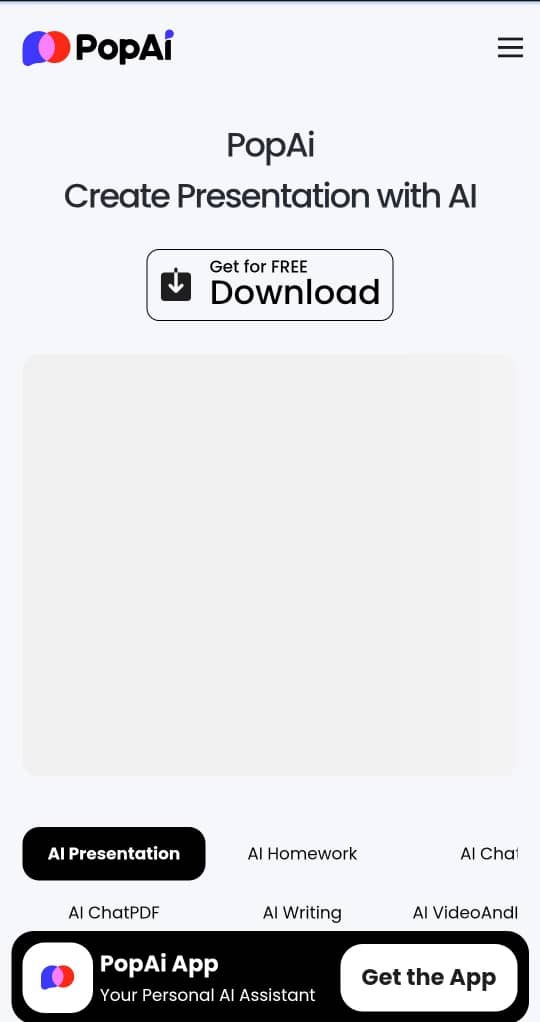
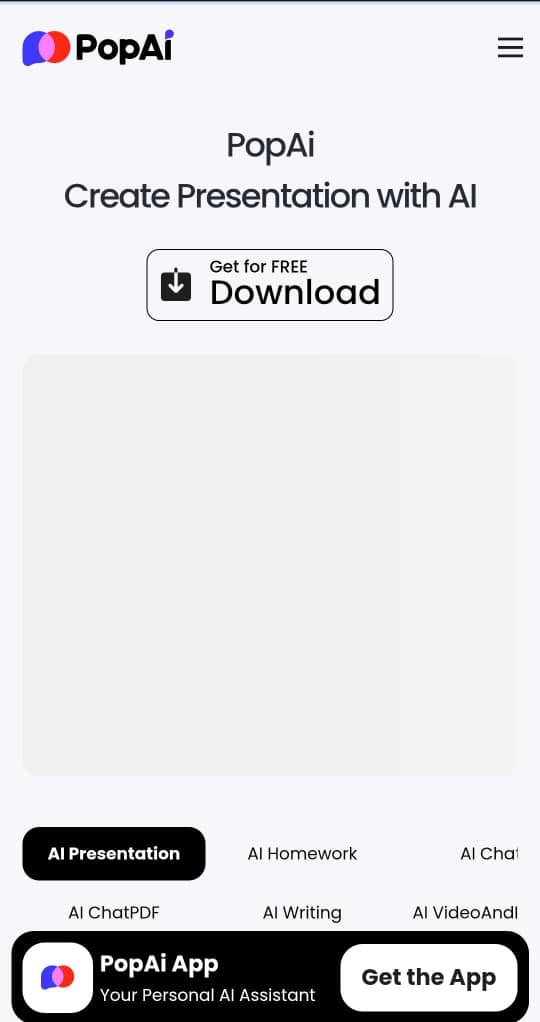
It looks like the link you provided leads to the landing page for PopAi, which describes a tool aimed at “document interaction,” “image-generation,” “homework help,” and “automatically turning ideas into PowerPoint slides.” I’ll review the content of that page and give you a detailed summary and critique (about 900 words as requested). If you meant something else (e.g., a full product, a user agreement, or a deeper document), let me know and I can dig further.
Summary of the page
The landing page presents PopAi as a platform with the following key features:
- It promotes “seamless navigation, enhanced readability, and universal accessibility” for “intricate documents.” Users can magnify details and tailor the layout for clarity.
- It highlights image-generation capabilities: “generate images on command, access image prompts and generation codes.”
- It offers “image-based homework help,” suggesting an educational use case with visual aids.
- It allows turning ideas into slide decks: “input your topic and PopAi crafts customizable outlines with smart layouts and automatic illustrations.” Users can edit online and export as PPTX or share via link.
The page repeats much of the same wording in two consecutive paragraphs (lines ~1-3) emphasising the document interaction feature, and then repeats the image-generation + homework help + slides feature.
In effect, the page is a high-level pitch: PopAi is positioned as a multi-purpose intelligent document/visual workspace, bridging advanced document navigation + image generation + presentation workflow.
What appears to work / strengths
- Clear high-level value propositions: The page immediately tells you what the tool is meant to do: improve document navigation, generate images, convert ideas into presentations. For someone skimming, the “turn ideas into PowerPoint slides” line is a strong hook.
- Multiple use-cases: By combining document navigation, visual generation, and presentation creation, the product addresses different user needs: students (homework help), professionals (slides), creators (image generation). That breadth may appeal to different segments.
- Simple call to action: It encourages the user to “input your topic” and get a customizable outline and automatic illustrations. This gives a concrete action.
- Emphasis on visuals: The mention of “image-based homework help” and “automatic illustrations” indicates the product is not just text-based. That’s important in today’s visual-first workflows.
What is unclear / potential weaknesses
- Lack of detail on how it works: The page is very high level and marketing-oriented. It doesn’t explain how the “document navigation” actually functions: what document types, how the magnify/tailor interface works, how “intricate documents” are handled. Similarly, for image generation: what engine is used? What’s the quality? Are there example outputs?
- No pricing or trial info visible: On a landing page, many users expect at least a hint of cost/tier or a “free trial” mention. Without that, users may hesitate.
- Repetitive wording: The two paragraphs of copy cover nearly the same content with minimal variation. That may convey less thoughtfulness in copywriting and could reduce credibility.
- Unclear target user-persona: The product mentions “homework help” (students), but also “PowerPoint slides” (business), and “intricate documents” (maybe legal/technical). Without clarifying which segments are the primary focus, the message may feel scattered.
- No social proof or testimonials: There are no visible quotes, user statistics, or case studies to demonstrate that the tool is already used and works well. For a new product, that can reduce trust.
- No description of security/privacy: Since this involves documents and images (likely user’s own content), users may want to know how the data is handled (privacy, security, confidentiality). The page does not cover this.
- URL and Branding Slightly Ambiguous: The link you shared is a tracking/affiliate link (pxf.io) to the actual site. Some users may be cautious about the affiliate redirection. Also, “PopAi” is a somewhat generic name, so it might face discoverability or branding challenges.
Recommendations for improvement
- Add concrete examples/screenshots: Showcase “before and after” of how the document navigation improves readability; show sample generated images; show a slide deck generated from a topic. Visual proof builds trust and clarifies value.
- Clarify user personas and use-cases: Create three tailored mini-sections: Students (homework help & visuals), Professionals (quick slide creation), Creatives/Researchers (document navigation & image generation). This helps visitors identify with the product quickly.
- Pricing & trial details: Include a section like “Try free for 7 days” or “Subscription starts at £X/month”. That gives transparency and helps conversion.
- Social proof / testimonials / case studies: “Used by 2,000 students worldwide”, “Generating 500 slide decks per month”, or quotes from actual users helps build credibility.
- Security & privacy information: Especially when dealing with “intricate documents”, users will want reassurance “we never store your documents”, “256-bit encryption”, or “GDPR compliant”. Add a footer or modal for “Data & Privacy”.
- Differentiate the product: Since the name “PopAi” and the features (image generation + slides) are somewhat common in AI productivity tools, emphasise what makes it unique: maybe the document navigation interface, or the “image prompt + generation code” export, or the streamline from topic→outline→slides.
- Refine copywriting: Avoid repeating the same sentences back‐to‐back. Ensure each paragraph adds fresh content or context. Also consider adding benefit-oriented language (“Save 70% of your slide-prep time”, “Turn a 50-page PDF into a searchable outline in seconds”, etc.).
- Stronger call-to-action (CTA): Add a distinct button (“Start free trial”, “See live demo”, “Generate your first slide for free”) prominently near the top. The current copy mentions “input your topic” but doesn’t clearly link to where or how to do it.
Market positioning & competitive context
In the current AI productivity landscape, there is growing competition in the areas of slide-generation (e.g., AI tools that turn outlines into PowerPoints), visual generation (e.g., DALL·E, Midjourney, Stable Diffusion), and document intelligence/navigation (e.g., tools that summarise, search PDFs, zoom through complex documents). PopAi appears to combine all three, which is a strength: bundling features across domains. However it also means PopAi must deliver on each one to compete effectively.
Because each of these domains is crowded, it will be critical for PopAi to show depth (not just breadth). For example, many tools can generate images; what makes PopAi’s image system special (prompt customization, code export, education-friendly visuals)? Many tools can create slides; what makes PopAi’s slide workflow better (automatic illustrations, layout intelligence, one-click export)? Many tools can navigate documents; what makes PopAi’s document interface superior (magnify details, tailor layout, accessibility features)? Having distinct, documented advantages will help stand out.
Target user benefit / pain points addressed
From the copy, the benefits appear to be:
- For someone dealing with complex documents: The navigation/magnification/layout features reduce frustration when reading or analysing large PDFs, technical reports, manuals.
- For someone needing visual content: The image generation and prompt/code access allow them to create illustrations, diagrams, homework help visuals quickly.
- For someone creating slide decks: The “input topic → outline → slides” workflow means less manual design/time-spent, faster turnaround.
The corresponding pains addressed:
- Time wasted formatting slides, designing visuals.
- Difficulty reading/understanding “intricate documents”.
- Lack of tools that integrate text, visuals, presentation in one workflow.
If PopAi delivers on these reliably, it could be valuable to students, educators, researchers, consultants and business professionals.
Potential risks / concerns for users
- If the image generation requires high compute or is limited in quality, users might feel the output is inadequate compared with dedicated tools.
- If document navigation is “just a PDF viewer with zoom” and lacks genuine intelligence (semantic search, summarisation), users may feel underwhelmed.
- The export to PowerPoint (PPTX) is useful, but if formatting is poor or further manual editing is required, the “automatic” claim may fall short.
- If the tool is expensive or has hidden costs, that could deter adoption.
- Since the site includes affiliate tracking (pxf.io) in the link you shared, users may question the independence/trustworthiness of the site or its claims.
Overall impression
Overall, the landing page is effective in grabbing attention: the big claims (image generation, slide creation, document navigation) are appealing and relevant. The style is succinct and benefit-oriented. However, it still feels early-stage: lacking detailed proof, personas, pricing, testimonials, and the copy could be sharpened.
If I were a visitor, I’d be intrigued and might click-through to learn more, but I would hesitate to subscribe without seeing an example or trying the product. With enhancements (as above) I believe the conversion potential could be significantly higher.
Recommendation of next steps (for you or for PopAi team)
- User testing: Have a small cohort of students, business professionals, and researchers try the workflow “topic → outline → slides” and collect feedback/screencasts. Use those as examples on the site.https://01aipteltd.pxf.io/PO7EMR
- Create a demo video: Show a 2-minute walkthrough of PopAi in action: pick a topic, generate an outline, then export and open in PowerPoint, show editing.
- Add “examples gallery”: A section with real slide decks, visuals, or document-interaction snapshots.
- Clarify pricing & offers: e.g., “Free plan supports 2 slide decks/month, paid plan £9.99/month for unlimited”. Offer a free trial.
- Strengthen branding content: Perhaps a tagline such as “From idea to presentation in one click” or “Visualise your documents, generate slides, image-on-demand”.
- Highlight unique features: If there is unique tech (e.g., you can export the image generation prompts/codes, you can customise layouts intelligently), call these out with icons/mini-headings.
- Add trust indicators: Security badges, refund policy, user counts, testimonials, logos of organisations using the tool.
- Refine copy to avoid repetition: Ensure each paragraph adds a new benefit or explanation, avoid verbatim repeats.
If you like, I can review the next pages of the site (pricing, features, demo) and provide an in-depth evaluation including UX, value proposition, competitive positioning and suggested copy improvements — would you like me to do that?
visit affiliate https://01aipteltd.pxf.io/PO7EMR